

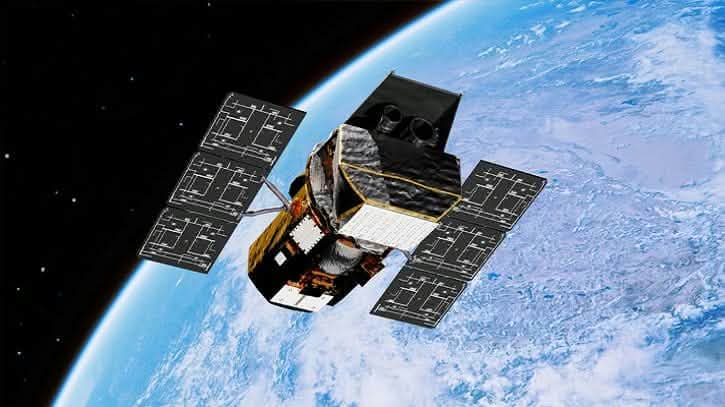
A NASA space telescope weighing approximately 1.5 tonnes is expected to re-enter Earth’s atmosphere, raising concerns that some of its debris could survive the fiery descent and reach the Earth’s surface. India, along with parts of Africa, Australia, Southeast Asia, and Central and South America, falls within the potential debris impact zone.
The spacecraft, known as the Neil Gehrels Swift Observatory, was launched on November 20, 2004. Initially named the Swift Gamma-Ray Burst Explorer, the telescope has spent nearly 22 years in space and is now approaching the end of its mission. According to NASA, the observatory is expected to re-enter Earth’s atmosphere at approximately 3:30 a.m. Eastern Time on November 4, corresponding to around 2:00 p.m. Indian Standard Time. However, the estimated timing remains uncertain by approximately 11 hours.
Most of the spacecraft is expected to burn up during atmospheric re-entry, although some components could survive and reach the ground. Brad Cenko, the mission’s principal investigator, told the Associated Press (AP) that potential debris landing areas include parts of Africa, Australia, India, Southeast Asia, and Central and South America. NASA estimates that the possible re-entry zone lies between 20.6 degrees south latitude and 20.6 degrees north latitude, forming a broad belt around the Earth’s equatorial region.
In India, the potential zone includes areas south of an imaginary line extending from Daman on the western coast to Cuttack in Odisha on the eastern coast. Major cities within this broad region include Mumbai, Hyderabad, Bengaluru, and Chennai. However, Delhi, Kolkata, and much of northern India lie outside the projected zone. Being within this latitude range does not necessarily mean that debris will fall in any of these cities.
The actual landing location will depend on the spacecraft’s precise position when it enters the atmosphere. India has its own technological capabilities to monitor objects returning from space. The Indian Space Research Organisation (ISRO) operates the Multi-Object Tracking Radar (MOTR) at Sriharikota, which can detect and track various space objects, including rocket debris and satellites, while they are still in orbit before atmospheric re-entry.
However, ISRO has not publicly confirmed whether it is currently monitoring the incoming Swift Observatory. Some experts believe that the debris is more likely to fall into the ocean. Astrophysicist Jonathan McDowell, an honorary professor at Durham University, told Gizmodo that a large portion of the potential impact zone consists of oceans. He estimated that he would be surprised if even 100 kilograms of the spacecraft’s total mass of approximately 1,500 kilograms survived atmospheric re-entry.
Brad Tucker, an astrophysicist at the Australian National University, told ABC News that nearly 70 per cent of the Earth’s surface is covered by oceans. Consequently, the probability of an object landing on land is relatively low. Experts say the likelihood of debris striking populated areas or infrastructure, or causing injuries, is extremely small. NASA’s efforts to prevent the spacecraft’s uncontrolled descent have been unsuccessful.
Although the mission was initially designed to operate for just two years, the observatory remained active far beyond its expected lifespan. During its nearly 22-year mission, it detected more than 2,000 gamma-ray bursts and observed approximately 1,400 supernovae. Now, after more than two decades of scientific observations, the Swift Observatory is preparing for its final journey back to Earth.